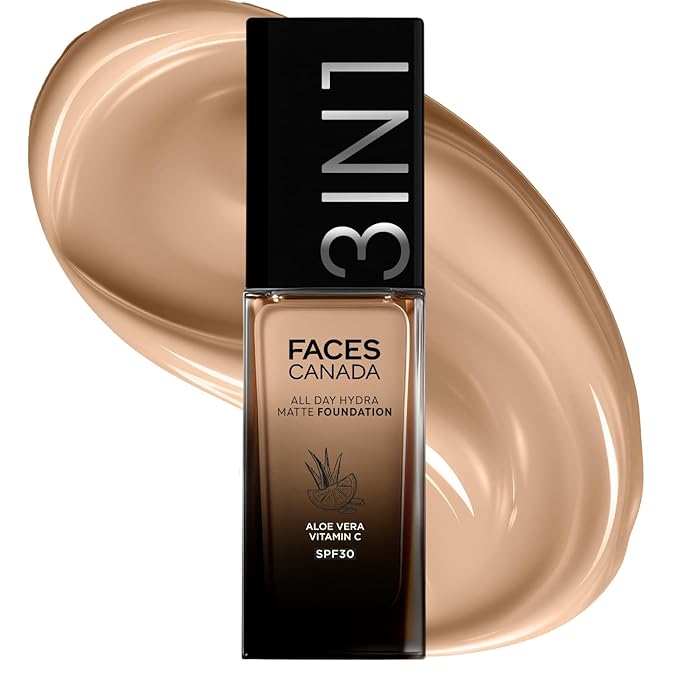
-
-
Avoid fragrance, certain alcohols, harsh matte agents. Look for dermatologist‑tested, hypoallergenic, or gentle skin formulas.
-
Patch test optional, especially if skin has eczema, rosacea etc.
-
Price range: ₹398.00 through ₹417.00
Avoid fragrance, certain alcohols, harsh matte agents. Look for dermatologist‑tested, hypoallergenic, or gentle skin formulas.
Patch test optional, especially if skin has eczema, rosacea etc.
A matte foundation is a type of makeup base whose finish aims to minimize or eliminate shine from the skin. Instead of giving a glow or dewy look, matte foundations produce a flatter, more uniform, non‑reflective appearance. They are available in various formats — liquid, cream, powder, stick — and are particularly formulated to absorb surface oil and reduce glossiness. spiegato.com+1
The term “matte” means devoid of luster and shine. Matte foundations tend to set more firmly than glowy or radiant foundations, which can make them longer‑wearing. spiegato.com+1
Here are several advantages of choosing a matte foundation:
Oil Control / Shine Reduction
Matte formulas absorb excess sebum produced by the skin, reducing shine especially in oily or combination skin types. spiegato.com+2Necole Bitchie+2
Long‑Lasting Wear
Because they are less influenced by oils and sweat, matte foundations usually last longer without needing touch‑ups. Pros & Cons Reviews+1
Even Skin Tone & Imperfection Coverage
They are good at concealing blemishes, discolorations, pigmentation, and evening out the skin—creating a smoother surface. Pros & Cons Reviews+1
Pore Blurring / Texture Minimization
Matte foundations often contain ingredients or powders that soften the visibility of pores and fine texture. spiegato.com+2Necole Bitchie+2
Non‑Greasy Finish
They help garments, accessories or hair not pick up foundation, and less transfer to surfaces (glasses, phone, hands) especially in humid or oily skin conditions. MyLuxeLook+1
Good Base for Other Makeup
With shine controlled, other products like blush, bronzer, lipstick tend to hold better and stay true to color without slipping. Necole Bitchie+1
While matte foundations offer many advantages, there are trade‑offs. Knowing them helps in choosing the right product and applying it well.
Can Exacerbate Dryness
Because they often remove or reduce surface moisture and absorb oils, matte foundations may dry out patches of skin, highlight flakiness, or make dry skin look dull. spiegato.com+2Pros & Cons Reviews+2
May Highlight Fine Lines and Texture
If the skin has wrinkles, lines, or rough texture, matte foundation may settle into them, making them more visible. Pros & Cons Reviews+1
Risk of Cakey or Heavy Look
If applied too thick, poorly blended, or without proper skin prep, matte formulas can look unnatural and heavy. Pros & Cons Reviews+1
Long Removal Process
Due to durable, oil‑absorbing or setting powders/silicone compounds, matte foundation may be harder to remove fully. Inadequate removal may clog pores or cause irritation. spiegato.com+1
Limited Comfort in Very Dry or Harsh Conditions
In cold or dry climates, or for people with naturally dry or mature skin, matte finish may feel tight or accentuate dryness. spiegato.com+1
Understanding what goes into matte foundations helps in picking formulas suited for your needs.
| Ingredient / Component | Role / Benefit | Considerations |
|---|---|---|
| Silica | Absorbs oil, gives smooth finish. Helps reduce shine. positivephysics.blog+1 | Can be drying for very dry skin. |
| Kaolin Clay | Absorbs sebum, matify, helps with oil control. positivephysics.blog | Needs adequate hydration underneath. |
| Dimethicone / Silicones | Provide smooth application, help with blending, can fill/minimize pores. INCIDecoder+1 | May trap oils/dirt if not removed well; some people prefer silicone‑free. |
| Niacinamide | Helps with skin barrier, may reduce redness, improve skin texture, help with oil regulation. INCIDecoder | |
| Emollients / Moisturizers (in small amounts) | To prevent drying out; keep skin comfortable. Even matte formulas may include humectants like glycerin. INCIDecoder+1 | |
| SPF / UV Filters | Some matte foundations include SPF protections. INCIDecoder+1 | |
| Pigments (Iron Oxides, Titanium Dioxide) | Provide color, coverage, tone matching. Some also give sun protection. INCIDecoder+1 |
Choosing whether matte foundation is suitable depends a lot on skin type, and sometimes combining it with other skin care steps helps.
| Skin Type | Suitability | Tips to Make Matte Work Better |
|---|---|---|
| Oily Skin | Highly suitable. Helps reduce shine, control oil, long wear. | Use mattifying primer; blotting powder; ensure good color match. |
| Combination Skin | Good choice, especially for T‑zone. Use variations: matte on oily zones, maybe more natural finish elsewhere. | Use lighter hydration on dry areas; spot matte. |
| Normal Skin | Often works well; provides even finish without overly drying, if formula balanced. | Use hydrating base or primer; keep skin care routine solid. |
| Dry Skin | Challenging. Matte foundations can highlight flakes or dry patches. | Exfoliate regularly; moisturize well before makeup; use hydrating primer; consider “soft matte” or hybrid formulas. |
| Mature Skin | Some risk: fine lines and loss of elasticity can show more under matte finishes. | Use smoothing / blurring formulas; avoid thick coverage; use minimal powder over edges; provide moisture underneath. |
| Sensitive / Acne‑Prone Skin | Depending on ingredients. Oil‑free, non‑comedogenic matte foundations are preferable. Pros & Cons Reviews+1 | Patch test; avoid irritant ingredients; ensure full removal at end of day. |
Matte foundation is not one single style—there are multiple subtypes depending on formula, finish, and wear.
Full Matte / True Matte
These leave almost no sheen. They are excellent for heavy oil control and situations where you want absolutely no shine. Usually heavier in coverage.
Soft Matte / Natural Matte
These offer a compromise—matte finish with some life or dimension in skin; less stark, less flat.
Long‑Wear Matte
Designed to stay put for many hours (12‑24+), resisting oil, sweat, humidity.
Powder Matte Foundation
Great for touch ups or for those who prefer drying to a matte effect with minimal steps.
Liquid / Cream Matte
More blendable; can offer more coverage with controlled oil gloss; often used with primers and setting powders.
Hybrid Finishes
Some “modern matte” or “matte + soft glow” formulas try to combine matte effect with slight luminosity (e.g. a diffused matte, somewhat blur‑effect) so skin doesn’t look too flat. Allure+1
Here are the factors to consider when selecting a matte foundation fit for your skin needs and preferences.
Shade Matching: Undertone (warm, neutral, cool), depth of skin, and any changes during seasons.
Coverage Level: Light, medium, full. If you need to cover blemishes / pigmentation, a higher‑coverage matte may be needed.
Finish Style: True matte vs soft matte vs long‑wear hybrid matte.
Ingredient Preferences: Oil‑free, non‑comedogenic, SPF, fragrance‑free, etc.
Skin Condition: Dry, oily, combination, mature, acne‑prone, sensitive.
Climate & Weather: Hot/humid weather may increase oil production; winter/dry climates may increase dryness.
Longevity & Wear: How many hours you need it to last without touch‑ups.
To make matte foundation look its best and avoid common pitfalls, follow these tips:
Skin Preparation
Cleanse, exfoliate, and moisturize properly. Even matte formula needs skin with good texture.
Use primer, especially matte or oil‑control primers in oily areas. For dry areas, hydrating or smoothing primer may help.
Tools Choice
Use damp sponge, dense brush, or your fingers depending on texture.
For powders, use a buffing brush or puff.
Layering
Apply in thin layers. Better to do two thin layers than one thick layer.
Spot‑apply more where needed.
Blending
Blend well, especially at edges (jawline, hairline, nose), so the finish looks natural.
Setting
Use setting powder or translucent powder in oily zones.
Use setting spray if available, to reduce powdery look and improve wear.
Touch‑Ups
Carry blotting papers or mattifying powder for midday shine control.
Avoid piling on more foundation; use powder or touch up lightly.
Removal
Use oil or balm based remover first to dissolve foundation, then follow with gentle cleanser.
Be thorough: remaining foundation can cause clogged pores, breakouts or dull skin.
To get the best out of matte foundation and avoid undesirable effects:
Using wrong shade or undertone → can make skin look dull or mask appears unnatural.
Neglecting hydration → produces patchiness or emphasizes texture.
Applying too much → leads to cakey or heavy finish.
Using the wrong tools → e.g., using dry sponge, poor brushes leads to streaks or uneven finish.
Skipping setting or not using blotting → shine builds up, makeup slips.
Not removing properly at end of day → leads to skin irritation.
It’s useful to see how matte foundation stacks up against other foundation finishes.
| Characteristic | Matte Foundation | Dewy / Glowy Foundation | Satin / Natural Finish |
|---|---|---|---|
| Shine / Glow Level | Minimal / none | High gloss or glow | Moderate, balanced |
| Best for Skin Types | Oily, combination, acne‑prone | Dry, mature, dull skin | Normal, combination, those wanting balance |
| Texture Visibility | Can highlight pores or fine lines if skin not prepped | More forgiving; often smoothes out lines via glow and light reflection | Balanced‑visibility; moderate reflection softens texture |
| Wear in Heat / Humidity | Generally better; less slip | May slide, become too shiny | Varies, depending on formula |
| Maintenance / Touch‑ups | Needs blotting, powder, careful prep | Might need minimal touch‑ups to keep glow fresh | Moderate maintenance |
As beauty evolves, matte foundation has also seen innovations:
“Soft Matte” / “Flawless Matte” that includes skin‑balancing or moisturizing ingredients to avoid flat finish.
Powders + Liquids hybrids to combine longevity and matte properties with lighter feel.
SPF / Skin Care Infusion: Foundations that double as skincare—adding hyaluronic acid, niacinamide, antioxidants—while still delivering matte finish. INCIDecoder+2INCIDecoder+2
Wider Shade Ranges to include many skin tones and undertones. Allure+1
Better Formulas for Dry / Mature Skin: more forgiving formulas that don’t emphasize texture too much.
Matte foundation works best in certain circumstances or for certain users:
People with oily or combination skin who find their skin becomes shiny over hours.
Individuals attending long events, outdoor settings, humid weather where makeup might slide or shine.
When one wants a high‑definition finish for photography or video, where non‑reflectivity helps reduce flashback or glare.
For professional or formal settings where a polished, non‑shiny appearance is desired.
In contrast, those with very dry skin, or during cold/dry climate may prefer less matte or more luminous formulas, or use matte only on certain zones.
If your skin tends toward dryness, sensitivity, or maturity, but you’d still like some of the advantages of matte foundation, here are ways to adapt:
Use hydrating serums or moisturisers before makeup. Allow them to fully absorb.
Use primer that adds a slight dew or glow but still helps with smooth texture.
Mix in a drop of facial oil or luminous drops with the foundation to adjust the finish.
Use “soft matte” formulas (matte but with more flexibility or moisture).
Focus matte more on oily zones (T‑zone), and less on cheeks / temples.
Avoid heavy powdering over dry areas; instead lightly dust or use only in necessary zones.
In sum:
Matte foundations are powerful tools in your makeup kit, especially if you want control over oil, shine, and a polished, long‑wearing complexion.
But, like any high‑performance product, they have limitations and require good skin prep and the correct formulation to avoid highlighting undesirable skin texture or dryness.
The best matte foundation choice depends strongly on your skin type, environment (weather, humidity), how long you need it to last, and how you like your finish (flat matte vs soft matte).
Innovations and newer formulas are making matte more forgiving and comfortable than before; the gap between matte and radiant is narrowing with hybrid technologies.
Matte foundations are not static; the beauty and cosmetics industry keeps evolving, particularly in how matte finish is achieved without sacrificing comfort, skin health, or natural look. Here are key innovations & technological trends as of 2024‑2025.
New foundations use advanced film‑forming agents/polymers that create a lightweight, breathable layer over skin. This helps with resisting sweat, humidity, and transfer (when your makeup rubs off). The film gives matte control but is flexible, so it moves with facial expressions rather than cracking. Dovs Makeup
These formulations often combine volatile silicones or “volatile oils” with acrylic or polymer networks that set firmly but are thin enough that you don’t feel heavy. Dovs Makeup+1
Smart oil‑control particles can respond to sebum (skin oil) levels—they absorb extra oil when skin gets oily and vacate or dissipate when skin is normal. This helps mitigate one of the biggest problems matte foundations have: over‑matte that looks flat or caked. Dovs Makeup
Ingredients like porous silica, modified starches, or Sebustop (in Indian innovations) help in reducing shine and making the finish last longer without becoming heavy. For example, the Nykaa “Matte To Last Pore Minimizing Foundation” uses 2% Sebustop; it’s designed for Indian skin types / weather, promising long wear, oil control, and reduced pore visibility. The Purbottar+1
Brands are creating “lumi‑matte” or “light long‑wear” matte finishes—i.e., matte but with a very subtle luminosity, so skin doesn’t look dead flat. The finish gives the control matte provides (shine minimization) with a more natural skin look. For example, Maybelline’s “Super Stay Lumi‑Matte Foundation” is described as lightweight, long wear, breathable, with a subtle glow under the matte finish. TrendHunter.com
Such formulas often include amino acids, light‑diffusing particles, or microfine soft‑focus powders. These make pores or texture less visible. The key is balance: enough mattifying agents to control sheen but also enough skin‑friendly ingredients to avoid dryness.
One complaint many people have with foundations (especially in warmer, humid climates) is oxidation—that is, the foundation changes shade or becomes darker/oranger than when first applied. Innovations now include antioxidants, color‑stabilizing agents (e.g. vitamin C derivatives, plant polyphenols) that help preserve the shade and brightness. Dovs Makeup+1
Stable pigment technology is also improving. Pigment particles are being coated or treated to resist environmental (air / UV) or sebum‑related changes.
Because matte tends to dry out skin, many newer foundations come with skin‑adaptive textures—meaning the formula includes humectants (for moisture), emollients that don’t compromise matte (light oils, esters, etc.), and often glycerin or similar ingredients to prevent feeling tight.
Also, there’s the trend of “second skin” feel: thin sheeting, minimal layering, so makeup feels less like a mask. Micro‑emulsion technologies, soft focus powders, feather‑light silicones etc. are used to give smooth texture. Dovs Makeup
The Indian market and many global beauty markets are demanding broad shade ranges, especially with correct undertone representation. Brands are launching more shades, undertone descriptors (warm / cool / neutral / olive), and also improving their testing in different lighting or weather to ensure the foundation works across different skin tones. For example, Nykaa’s Matte To Last range launched in 15 Indian shades. The Purbottar+1
There’s a trend too toward personalized or customizable foundation: mixing shades, using drop blends, or offering neutral undertones for those in between warm/cool.
A matte foundation can look perfect in texture and finish but wrong in color if undertone or shade is off. For Indian skin tones—especially with regional and seasonal variation—the matching process has several subtleties.
Skin tone refers to how light or dark your skin is, what category (fair, medium, tan, deep etc.).
Undertone is the underlying hue (warm, cool, neutral, olive) that stays constant despite sun exposure, darkness/tanning etc. It has major influence on whether foundation looks natural on you.
Indian skin tones are diverse. Many Indian complexions have yellow, gold, or olive undertones. Some have neutral undertones that combine warm + cool, and others have slightly peach or red undertones (especially in areas with redness or pigmentation). Vogue India+2Juse Beauty+2
Some methods:
Vein Test: Look at veins on your wrist. Blue/purple suggests cool, greenish suggests warm/olive; mixture implies neutral. Maybelline India+2Nykaa+2
Jewellery Test: Do you look better in gold (warm) or silver (cool)? If both work, you’re likely neutral.
Sun Reaction: If you tan easily and don’t burn much, might be warm or olive undertone; if you burn or flush/pink easily, could be cool.
White Paper Test: Hold a white sheet beside your face—if your skin looks more yellow/golden next to it, warm; pinkish next to white: cool. BeBeautiful+1
Always swatch on jawline or lower cheek and blend outward. The color should disappear into skin, not stand out. Swatching just on hand or wrist is misleading. Maybelline India+2BeBeautiful+2
Check in natural daylight because indoor lighting can alter how colors appear. Warm bulbs can make things look more golden, cool bulbs more pale etc.
Let the foundation sit for a few minutes—it may oxidize (change shade slightly) when it interacts with your skin’s oils. Maybelline India+2Nykaa+2
Compare shade with your neck and chest as well; sometimes face has more pigmentation or undertone differences. The ideal shade blends into both neck and face. Vogue India+1
To simplify, many beauty experts divide into:
Fair to Light (light skin with warm‑yellow or olive undertone)
Medium / Tan (wheatish, golden, neutral)
Deep / Rich (dusky to deep, often with golden or olive undertones)
Here, “golden” or “yellow” undertones often flatter, since they enhance the natural warmth in many Indian complexions. A foundation with a cool/pink undertone may look (or turn) ashy. Vogue India+1
Even with the perfect formula, there are practical hacks and methods to make matte foundation look its best, especially under Indian climate, lighting, or skin challenges.
Exfoliate regularly (once or twice a week) to remove dead skin, so matte doesn’t catch on flakey patches.
Use a hydrating or balancing moisturizer. Even matte or oily skin needs moisture; lack of it makes matte finish look patchy or accentuate texture.
Apply a primer appropriate to your skin type: mattifying for oily T‑zone; smoothing or blurring primers for large pores; hydrating or glow primers under matte for dry areas.
Use damp sponge or beauty blender: it helps blend foundation evenly, reduces streaks.
Use dense brush only for areas needing more coverage; blend outward to thin out.
Apply in thin layers; better to layer than apply thick all at once.
Use translucent or skin‑tone loose powder in high‑oil zones (T‑zone, forehead, nose). A light dusting may help control shine without flattening the entire face.
Use setting spray after powder to reduce chalky or powdery look and to meld layers together.
Keep blotting papers handy for touch ups when skin oils break through.
Oxidation (Foundation turning darker/orange): Do not assume the product shade in bottle is what you’ll get; test and see after 10 minutes or more.
Wrong Undertone: This is more common than wrong depth. A shade too warm can look orange; too cool can look grey or pink.
Too Powdery / Dull Finish: Over‑powdering or using matte formula with no hydrating or balancing component can lead to dull or lifeless look.
Matte foundation behaves differently under different lighting, photography, and environmental conditions. Understanding this helps you choose and apply wisely.
Natural Light vs Indoor Light vs Flash / Studio Light: Matte looks flatter under flash if high specular highlights are removed; skin texture becomes more visible. So if you expect photos, using a soft focus or luminous powder/finisher may help.
Heat / Humid Environments: Indian summers or humid weather naturally increase oil production. Even matte foundation may break/slide/shine. Oil‑control primers, setting powders and sprays are more important.
Sweating / Physical Activity: If you expect sweat, choose long‑wear, transfer‑proof matte formula; keep blotting and avoid touching face.
Looking specifically at brands in India gives insight into how matte foundation is being tailored to local skin and climate realities.
Launched with 15 Indian shades to cover a range of skin tones. The Purbottar
Uses liquid‑to‑powder technology for a poreless matte finish that lasts up to 12 hours. The Purbottar
Hero Ingredient: 2% Sebustop – derived from plants, helps reduce oil, bacteria, and pore size. Suitable for oily/combination skin. The Purbottar+1
Vegan, dermatologically tested, paraben‑free, animal‑free. This reflects consumers’ growing demand beyond just look: ethics and skin safety are also important.
Fenty’s innovation is in adapting matte foundations to climates like India’s: balancing oil control with moisture retention. Fenty has offered formulas targeting hydration under matte and long wear without heavy feel. SPS COS
Global brands also increasing shade ranges for Indian undertones (warm, olive, golden), so what’s matte and what’s shade matching work together.
E.g. Trend It Up’s “Perfect Poreless Matte Foundation” includes niacinamide, which helps brighten and reduce blemishes, and is free from alcohol, fragrance and essential oils. This kind of formula reduces irritation, is gentler for sensitive skin, and offers multi‑benefit beyond just matte finish. INCIDecoder
Matte foundation isn’t one‑size‑fits‑all. Different skin textures, concerns, and types require more customized selection and use.
Use oil‑free, non‑comedogenic formulas.
Choose matte formulas with anti‑acne / antibacterial / sebum‑controlling ingredients (like Sebustop, silica, etc.).
Use mattifying primer on trouble areas.
Avoid heavy oils or greasy layers under foundation.
You may want to use matte finish only in oily zones (T‑zone, chin etc) and more natural or luminous finish elsewhere. Some people use two foundations (“zone foundation”), or mix matte & glow formula.
Apply matte foundation lightly in dry zones to avoid flakiness.
Matte foundation can highlight dryness, lines, fine wrinkles. To counter this:
Exfoliate regularly.
Use richer or more hydrating moisturizer underneath.
Use hydrating or radiant primer underneath matte.
Use “soft matte” formulas (matte but with skin preserving ingredients).
Use minimal powder or choose pressed powder with hydrating binders.
Avoid fragrance, certain alcohols, harsh matte agents. Look for dermatologist‑tested, hypoallergenic, or gentle skin formulas.
Patch test optional, especially if skin has eczema, rosacea etc.
Beyond skin and technical aspects, the finish of your foundation can affect how makeup is perceived and how you feel.
Matte finish tends to suggest polish, professionalism, sophistication. In many formal or work settings, matte look is preferred for its non‑shiny, even tone.
Matte can amplify skin texture, which sometimes is desired (a natural look) and sometimes not (if you want very smooth or airbrushed skin). Balancing is key.
Trends shift: for a while dewy/glowy was dominant; now matte‑natural hybrid is rising, and matte is being reinvented with comfort.
Cultural preferences matter: in India, with many weddings, events, photos, huge lighting, matte finish that lasts under heat or flash is especially valued.
| size | 25ml [pack of 1], 30ml [pack of 1], 25ml [pack of 2] |
|---|---|
| colour | Rich Ivory 013, Medium Natural 022, Rose Ivory 011 |


Reviews
There are no reviews yet.